Choosing your eFoil:
board and wings, what changes your stability and ride feel
Volume, construction, wing surface, aspect ratio: understand what really sets eFoil boards and wings apart before choosing your setup.
After our guide to batteries, here's the logical follow-up. When choosing an eFoil, people often think about range or motor power. Yet two elements define your experience on the water just as much: the board and the wings.
Volume, weight, materials, surface, shape… They're also the most customisable parts: most brands offer several board sizes and several interchangeable wings on the same fuselage. The right combination is worth understanding before choosing your setup.
Board volume: the first thing to look at
A board's volume is measured in litres (L). Think of it like the size of a buoy: the higher it is, the more the board floats, and the more stable it is at start-up, at low speed and at a standstill. More stability means more balance, so you'll learn to fly faster.
In practice, most manufacturers offer three volume families:
- High volume (100 to 150 L) : Beginner boards, very stable, easy to keep afloat even at a standstill. Suited to complete beginners and heavier riders.
- Mid volume (70 to 100 L) : The most common compromise once the basics are acquired, the most versatile and best-selling format.
- Low volume (50 to 75 L) : Lighter and livelier, reserved for experienced riders.
For a beginner, the rule is simple: go for more volume rather than not enough. A board too small for your weight makes learning to take off much harder.
Board weight
Weight mostly affects transport (carrying the board to the water) and also handling once in flight. On average, a board alone weighs between 5 and 15 kg depending on volume and construction, and a full pack (board + battery + motor + wings) usually falls between 20 and 35 kg. On a spec sheet, a few kilos of difference may look trivial. On the sand, or when handling the gear before and after every session, the difference is very real.
High-end carbon constructions save several kilos compared with fibreglass or inflatable constructions, at a higher price.
Construction and materials: carbon or fibreglass?
eFoil boards are built on a "sandwich" principle: a lightweight core (usually high-density EPS foam, sometimes reinforced with wood) is wrapped in thin layers of epoxy-laminated fabric, which form the board's rigid "skin". It's the nature of this skin that separates the two main families below : the core itself is never made of carbon or fibreglass.
Carbon boards
The skin is made entirely of carbon fabric. It's the most common construction among premium brands: it offers the best stiffness-to-weight ratio and the best fatigue resistance, but it's also the most expensive construction. On the highest-end ranges, you'll find pre-preg high-modulus carbon and titanium inserts for the battery mount, to maximise stiffness while minimising weight.
Fibreglass boards
Same construction principle, but with a fibreglass skin instead of carbon. The result is a little heavier and slightly more flexible than a carbon board, a flex that some riders even seek out for its softer feel on landing. It is, however, a noticeably more affordable construction, common on entry- and mid-range models, with good day-to-day durability.
Inflatable boards (drop-stitch)
A structure of tensioned drop-stitch fabric, inflated like a rigid paddleboard, sometimes complemented by a foam core. This is the entry-level option: cheaper, easier to transport and store (it deflates), but a little less rigid and less efficient in flight than carbon or fibreglass. This construction is designed for stability and accessibility rather than pure performance.
The mast
The mast that connects the board to the wing is generally made of anodised marine aluminium on entry- and mid-range models (durable, affordable), and carbon on the highest-performance setups (stiffer, transmits movement better, lighter).
The wings: the real driver of stability
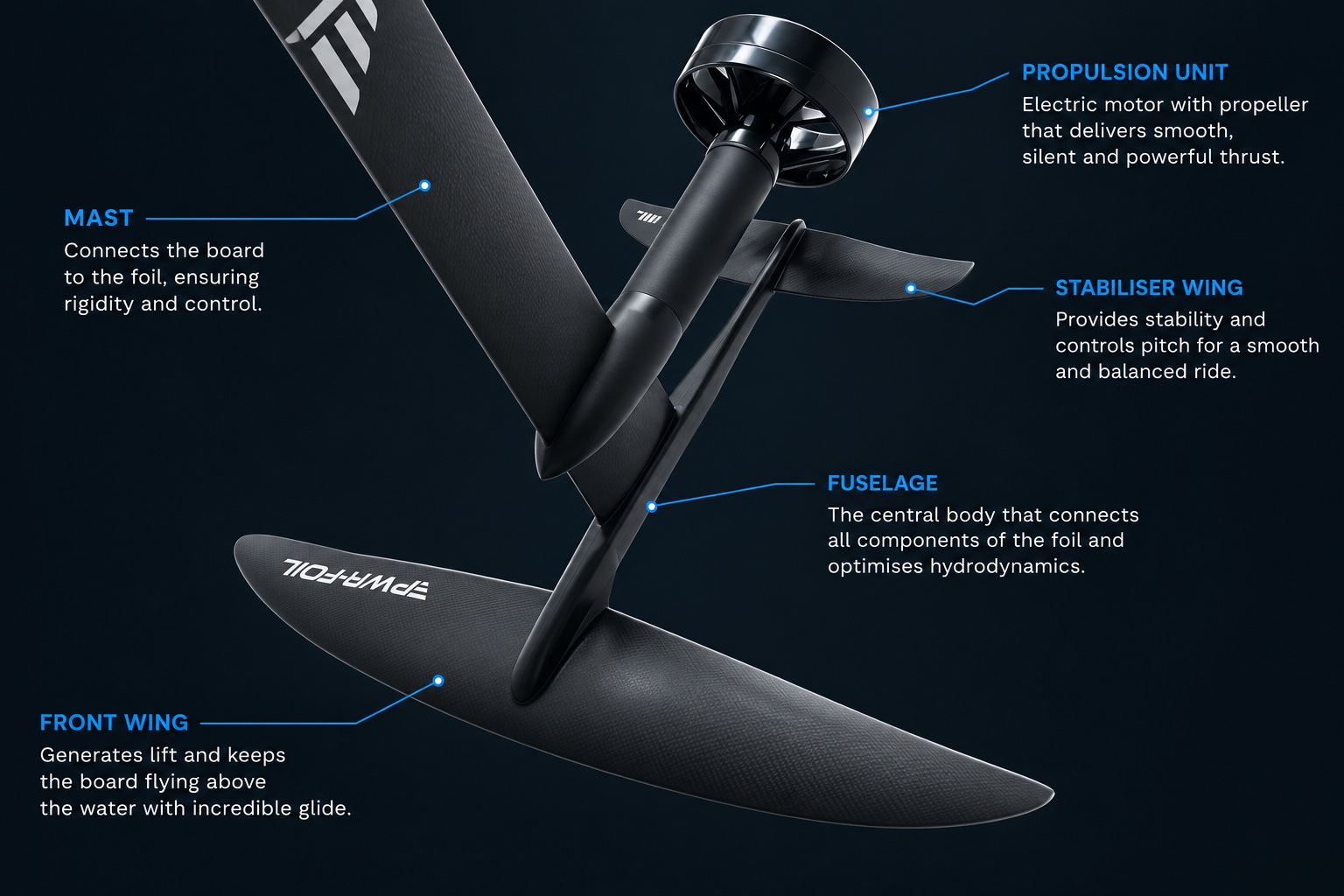
The wing is the part that generates lift and makes the board "fly" above the water, exactly like an aircraft's wings, the principle is the same. On most eFoils, there's a front wing, which carries most of the rider's weight, and a stabiliser (rear wing, smaller), which manages pitch and longitudinal stability.
Size and lift (cm²)
A wing's size is measured by its surface area (cm²). It's the parameter with the biggest impact on how the ride feels:
- Large wing (large surface area): generates lift from low speed, which makes take-off easier and flight more forgiving of mistakes. It's the recommended choice for learning, heavier riders, or relaxed/cruising use. In exchange, top speed and turning liveliness are more limited.
- Small wing: takes off at higher speed and demands more technique, but offers more liveliness, better cornering and a higher top speed. It's the choice of experienced riders after performance or carving (leaning into fluid, banked turns, using body weight to trace clean lines).
As a general guide, a beginner front wing is most often between 1,400 and 2,000 cm², and a rear stabiliser generally ranges from 250 to 425 cm² depending on the level of stability sought. But beware: the right choice doesn't only depend on your level, it also depends on your weight : lighter or more experienced riders move toward smaller surfaces in search of liveliness, while beginners and heavier riders favour larger surfaces.
Aspect ratio: shape matters as much as size
Aspect ratio (the ratio between a wing's span and its width) shapes flight behaviour just as much as surface area does:
- High aspect ratio (long, narrow wings): very efficient glide, low drag, ideal for distance and energy efficiency, but less forgiving in tight turns.
- Medium aspect ratio: the most common compromise, balancing glide and control.
- Low aspect ratio (wider, stockier wings): very stable and forgiving at low speed, responsive in tight turns, but less efficient in a straight line and at high speed.
Wing materials
Same logic as for boards: aluminium is the entry-level material (robust, affordable, but heavier and more prone to saltwater corrosion over the long term), while carbon is the premium reference (light, stiff, very responsive, best fatigue resistance). Many ranges even offer each wing in two versions: fibreglass (more affordable) and carbon (lighter and more precise).
How to choose based on your profile
Three questions are enough to guide your choice:
What's your weight? It's the number-one criterion for the board: the heavier you are, the more volume (litres) you need to float comfortably at a standstill. Manufacturers generally list a recommended weight range for each board size.
What's your level? A beginner does best combining high board volume with a large front wing surface, even if it means "sizing down" as they progress. This is exactly why most brands sell boards and wings separately and interchangeably: you keep the same fuselage and evolve the wings as your level improves.
What riding style are you after?
- Cruising / relaxed rides: high volume, large wing with low to medium aspect ratio. Priority on stability and ease.
- Versatility / progression: mid volume, medium-surface wing, medium aspect ratio. The best-selling setup, designed to grow with you without changing boards.
- Liveliness / carving / waves: smaller volume, smaller wing with low aspect ratio (good turning responsiveness), carbon materials for lightness and response.
- Speed / distance / performance: low volume, high aspect ratio wing, full carbon construction (board + wings + mast) to minimise weight and drag.
In short, there's no single "best" board or wing: the right choice is the one that matches your weight, your current level, and the kind of sensations you're after on the water. Many riders start with a stable setup and later buy a smaller second wing to complement it, rather than replacing the whole pack.